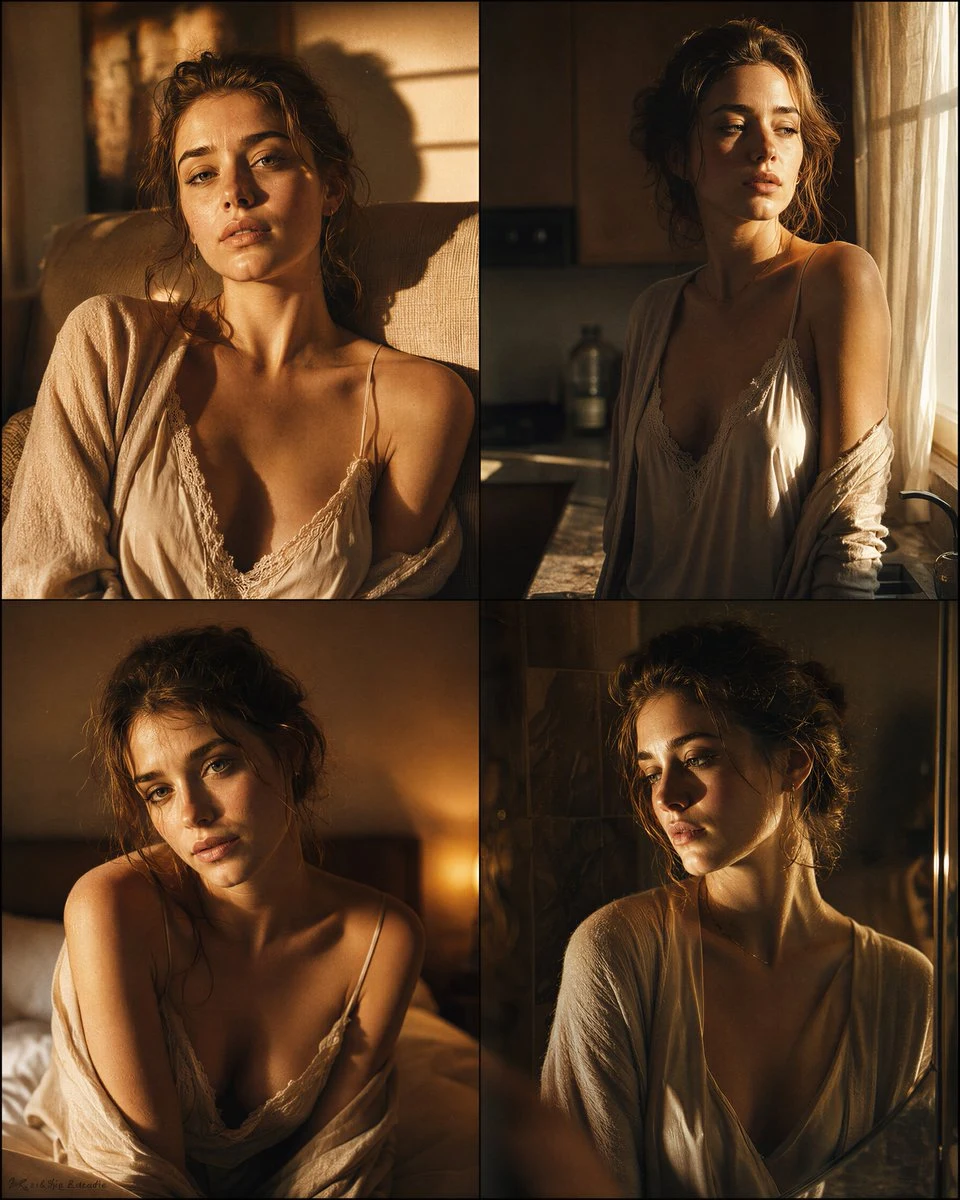
Create an ultra-premium four-panel lifestyle portrait board in the “Golden Room Sequence” direction, built on a strict 2x2 editorial grid. The same heroine appears in all four panels, and every panel must clearly show her face and visible expression changes. The board must preserve one unified cinematic domestic world, but each frame should present a different real home environment, a different camera angle, a different light direction, and a different emotional micro-expression. The final image must feel like one same woman moving through four connected private moments in the same warm, expensive, grain-rich visual universe. No readable text, no logo, no title, no typography, no graphic layout elements inside the image.

Core concept:
This is a same-series domestic portrait study centered on one healthy Western female model with refined bone structure, natural beauty, softly athletic elegance, and emotionally restrained presence. The visual language must be intimate, warm, cinematic, and luxurious, but more inward and more controlled than a normal lifestyle editorial. The board should feel like four film stills from the same afternoon, each captured in a different room or corner of the home, with different facial emotion and different shadow pressure. The emotional progression must be subtle but visible: calm stillness, quiet distance, softened contemplation, and near-private introspection.

4-panel structure:
Use a clean 2x2 grid with four equal panels and minimal spacing. All four panels must belong to the same visual world: same heroine, same styling family, same analog warmth, same grain-rich print atmosphere, same restrained sensuality, same domestic realism. Every panel must clearly show the face and enough of the eyes, lips, and facial planes to read a distinct emotional difference.

Top-left panel:
A sunlit sofa or armchair corner. Medium close portrait with the heroine seated, body angled slightly toward camera, face fully visible. Warm low-angle sunlight cuts across one side of the face and collarbone. Expression: calm, softly attentive, slightly lifted gaze, almost open but still guarded. The living-room environment should appear through upholstery, cushion texture, and a hint of window shadow, but remain secondary to the portrait.

Top-right panel:
A kitchen or dining-window environment. Three-quarter portrait with the heroine standing or leaning near a counter or window frame, face clearly visible, with one side softly lost in velvet shadow. Expression: more distant and thoughtful, eyes slightly turned away from the lens, lips softer and more inward. Light should be narrower and more concentrated, falling through curtain-filtered daylight and shaping the cheekbone and mouth.

Bottom-left panel:
A bedroom or bedside environment. Slightly lower-angle or closer portrait, still fully showing the face. The heroine may be seated at the bed edge or half-turned toward camera, with warm amber light touching only selected areas of the face, neck, and shoulder. Expression: more intimate, quieter, almost vulnerable, with a softer mouth and a more introspective eye line. Bed linen, blanket edge, or headboard shadow may appear, but only as subtle context.

Bottom-right panel:
A dressing corner, mirror edge, or bathroom threshold. Half-profile or gently turned portrait, but the face must still remain clearly readable. Use more diffused reflective light, with the cheekbone, eyelid, and lips softly illuminated while the rest recedes into deep warm shadow. Expression: most private and inward of the four, with a subtle emotional withdrawal, like the final hush of the sequence. Mirror edge, tiled wall, or dressing-surface reflection can be hinted at, but only minimally.

Face and expression logic:
Every panel must clearly show the heroine’s face and preserve readable differences in expression. Do not fragment the image so much that the face is lost. The variation must come from emotional nuance, not from hiding the face.
Panel 1: calm, slightly open, quietly present.
Panel 2: distant, reflective, lightly guarded.
Panel 3: intimate, softened, more vulnerable.
Panel 4: inward, private, almost withdrawn.
The eyes, lips, brow tension, cheek softness, and head angle must all contribute to these differences.

Heroine:
Use one same Western female model across all four panels, with luminous but natural skin, elegant cheekbones, refined nose and jawline, expressive eyes, and soft naturally shaped lips. She must feel real, sophisticated, and cinematic, never influencer-like, never over-retouched, never generic. Hair should be softly styled and slightly tousled, catching warm highlights in different ways across the four panels. Makeup must remain minimal, subtle, and natural.

Wardrobe and styling:
Dress her in elevated indoor wardrobe with an intimate but expensive domestic feeling: silk slip, fine camisole, soft knit, or similarly refined homewear. The wardrobe must stay in one same visual family across the four frames, with gentle variation in drape and pose but clear continuity of character. Fabrics must feel tactile, light-sensitive, and premium, with subtle folds and edge highlights.

Environment logic:
All four frames must be real domestic environments:
living-room sofa corner,
kitchen or dining window,
bedroom edge,
dressing or bathroom threshold.
The environment should be visible enough to distinguish the four settings, but always secondary to the heroine’s face and mood. Use only minimal cues such as upholstery, curtain, counter edge, bed linen, window frame, mirror edge, or wall texture. No clutter, no decorative overload, no distracting props.

Lighting:
Use extremely delicate low-intensity cinematic light with deeper velvet shadows and more concentrated highlights. The dark areas must feel richer, softer, and more luxurious, like warm velvet absorbing light. The bright areas must be narrower and more intentional, touching only selected facial planes, lips, eyelids, collarbone, shoulder, and fabric folds. Each panel must have a different light character while remaining in the same family:
one panel with stronger window bands,
one with curtain-filtered side light,
one with warm bedroom amber bounce,
one with diffused reflective dressing light.
The board must feel more inward, more expensive, and more filmic.

Shadow quality:
Push the shadows deeper and more velvet-like. The dark zones must feel dense, soft, rich, and tactile rather than empty. Faces should not disappear, but they should emerge from darkness with smooth falloff and luxurious depth. The shadow structure is essential to making the board feel more restrained and high-end.

Atmosphere and effects:
Add subtle premium atmosphere through realism only: suspended dust in sunbeams, faint golden room haze, tiny floating particles, slight lens bloom, low-contrast air density, and gentle analog softness. The atmosphere should feel warm, inhabited, and cinematic, as if each room is filled with quiet breath and afternoon light. Keep all effects restrained and believable.

Printed grain aesthetic:
Apply a strong heavy archival print-grain treatment across the full board. The image must feel like a rare oversized collector-edition lifestyle print with dense analog grain, visible paper tooth, subtle scan texture, faint dust contamination, slight print wear, and tactile photographic richness. The grain must be clearly visible in shadow fields, upholstery, curtains, walls, bed linen, and low-contrast skin transitions. The dark areas should carry rich velvet grain while highlights remain elegant and controlled.

Extreme sharpness:
Despite the heavy print grain and soft atmosphere, preserve exceptional sharpness on key local details in every panel: eyes, lashes, iris edges, lips, collarbone edges, skin-plane transitions, hair strands, fabric folds, upholstery texture, curtain weave, and reflected highlight edges. Every face must feel tactile, alive, and premium. The contrast between grain-rich atmospheric darkness and razor-sharp portrait detail is essential.

Depth of field:
Use shallow-depth, close-focus portrait optics across all four panels. Foreground furniture edges, fabric layers, or background room details can fall into creamy blur, but the face in every panel must remain clearly readable and emotionally legible. Focus must feel intimate, expensive, and highly controlled.

Color direction:
Use a restrained luxury domestic palette of honey gold, warm ivory, pale cream, aged linen, muted blush, soft skin warmth, dusty beige, olive-shadow undertones, deep umber, and velvet brown-black darkness. The highlights must feel more concentrated and precious, while the shadows dominate more of the frame. The whole board should feel sun-washed yet shadow-heavy, intimate yet grand, quiet yet luxurious.

Mood:
cinematic, intimate, inward, restrained, luxurious, domestic, melancholic, grain-rich, tactile, shadow-rich, elegant, lived-in, collector-edition, expensive

Rendering style:
ultra-premium four-panel lifestyle portrait board, same heroine in four domestic environments, face visible in every panel, subtle expression changes across all four frames, warm golden-hour cinematic realism, deeper velvet shadows, concentrated highlights, heavy archival print grain, extremely sharp local details, intimate interiors, shallow depth of field, atmospheric dust and haze, museum-grade visual poetry, 8k, world-class image quality

Negative prompt:
readable text, logo, title, typography, graphic layout elements, missing face, hidden expression, influencer aesthetics, plastic skin, cluttered interiors, excessive props, harsh flash lighting, neon colors, cheap fashion look, over-retouched beauty skin, flat shadows, muddy blur, low-detail fabric