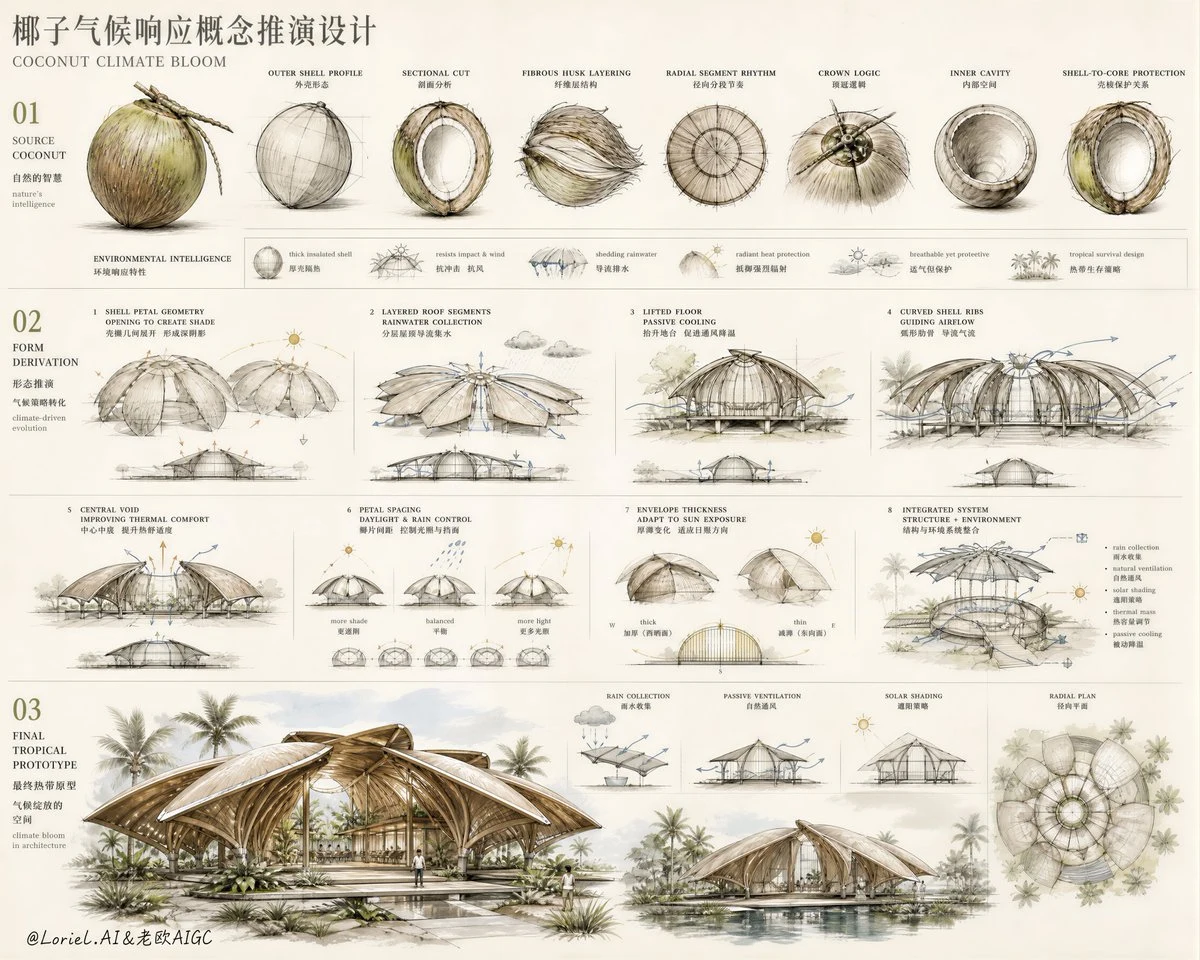
Create a premium concept evolution design presentation board, “Coconut Climate Bloom” edition, structured as a refined vertical concept-development sheet inspired by the organic geometry and climate intelligence of a coconut. The board must clearly communicate a three-part narrative: the top section shows the coconut as the biological source concept, the middle section presents informal hand-drawn and pale watercolor step-by-step climate-responsive design evolution, and the bottom section reveals the final resolved architecture. The overall sheet should feel like a world-class biomimetic architecture proposal: intelligent, elegant, analytical, tropical, and highly persuasive.

Overall board narrative:
The full composition must read like a professional concept evolution board for a tropical architectural prototype. The viewer should immediately understand that the coconut is not used as a decorative symbol, but as a performance-driven natural model. The top explains the source, the middle explains the climate logic, and the bottom shows the final architectural resolution. The board must feel highly organized, with elegant spacing, directional arrows, small analytical notes, soft hierarchy changes, and premium presentation rhythm.

Top section – Coconut source logic:
At the top of the board, show the coconut as the formal and environmental source of the project. Present several elegant studies of the real coconut: outer shell profile, sectional cut, fibrous husk layering, radial segment rhythm, crown logic, inner cavity, and shell-to-core protective relationship. These studies should feel like analytical extraction drawings, not simple botanical illustration. Use refined black or dark gray linework with pale watercolor or marker wash to highlight design-relevant features such as layered shell protection, segmented surface geometry, radial organization, thick insulating envelope, and natural response to sun, rain, and tropical heat.

Middle section – Climate-responsive evolution:
This is the conceptual heart of the board. Show a progressive sequence of architectural design studies derived from the coconut and transformed through climate logic. Present multiple non-final hand-drawn sketch stages, each explaining one performance idea:
- shell petal geometry opening to create deep shade,
- layered roof segments channeling rainwater collection,
- lifted floor or ventilated base for passive cooling,
- curved shell ribs guiding airflow and cross ventilation,
- central void or shaded atrium improving thermal comfort,
- roof petal spacing controlling daylight and rain protection,
- envelope thickening and thinning depending on solar exposure.
These studies should include perspective sketches, section cuts, exploded diagrams, airflow arrows, sun path notes, water collection traces, and structure-envelope relationships. The visual language must feel refined, rational, and beautifully hand-rendered, with confident linework and pale washes in muted tropical tones. The process should feel like a genuine climate-driven evolution from natural object to buildable spatial system.

Bottom section – Final design:
At the bottom of the board, present the final resolved architecture as a tropical climate-responsive pavilion or retreat prototype derived from the coconut logic. The final design should clearly preserve the coconut-inspired DNA: radial shell petals, layered protective roof, central core or shaded gathering space, organic opening geometry, passive ventilation logic, and integrated rainwater response. Show one or two stronger final perspective views with more confidence and resolution than the studies above, while still remaining in premium sketch-render language. The final architecture should feel buildable, elegant, site-aware, and highly suitable for a tropical environment such as a coastal eco-retreat, island pavilion, or climate-resilient cultural structure.

Architectural identity:
The final design must look biomorphic but intelligent, not literal or cartoonish. It should feel like a refined tropical eco-architecture concept inspired by the coconut’s climate wisdom. Express deep overhangs, layered shell petals, shaded circulation, open-air core, rain-filtering roof edges, breezeways, light structural ribs, and warm natural material cues. The form should suggest blooming shell geometry responding to heat, humidity, rainfall, and airflow.

Presentation style:
Use a high-end architectural concept-board language throughout: thin hand-drawn linework, clean arrows, subtle section labels, elegant micro diagrams, pale watercolor and marker wash, and a restrained paper-based aesthetic. The middle process sketches should remain clearly more informal, while the bottom final design gains clarity and authority. The whole board must look coherent, premium, and exhibition-worthy.

Color palette:
Use muted tropical and natural tones only: warm ivory paper, pale coconut husk cream, soft shell beige, muted olive green, light gray-blue, pale timber brown, warm sand, and gentle atmospheric green-gray. Keep the sheet airy and calm. Avoid bright colors and avoid overly decorative tropical styling.

Typography and layout:
Use a Chinese main title with an English subtitle, integrated elegantly like a real concept proposal board.
Chinese main title: “椰子气候响应概念推演设计”
English subtitle: “COCONUT CLIMATE BLOOM”
Add refined English micro labels across the board, such as:
“form derivation”
“shell logic”
“rain collection”
“passive ventilation”
“solar shading”
“final tropical prototype”
Typography must be thin, architectural, artistic, and clearly spaced. No crude bold fonts, no cluttered infographic feeling.

Lighting and rendering:
The top and middle sections should feel like hand-rendered concept studies on premium presentation paper. The final bottom views should have slightly more depth, soft environmental shadow, subtle material suggestion, and clearer spatial confidence while still staying within a sketch-render presentation language. The whole board should feel calm, polished, and museum-grade.

Mood:
intelligent, tropical, biomorphic, climate-responsive, elegant, analytical, calm, premium, sustainable, architecturally resolved.

Rendering style:
high-end architectural concept evolution board, biomimetic climate-responsive design analysis, pale watercolor and marker wash, elegant hand-drawn linework, premium presentation layout, tropical eco-architecture sketch rendering, museum-grade design sheet, 8k, sharp but graceful finish.

Negative prompt:
messy sketchbook page, random concept jumps, low-detail coconut study, literal cartoon coconut building, cluttered notes, ugly bold typography, cheap infographic layout, oversaturated watercolor, sci-fi spaceship look, disconnected evolution process, noisy background