GPT-5.4 vs Claude 4.6 vs Gemini 3.1: The Complete Comparison for Real Work
If you are trying to choose one frontier model for daily work, you are not really choosing a chatbot. You are choosing a working style. The best model for your team depends on whether you spend more time writing code, debugging production issues, reading long documents, evaluating sources, using tools, or stitching together many smaller tasks into one repeatable workflow.
This is why model comparison pages often feel incomplete. They compare benchmark labels, but they do not explain what the models feel like when you use them for a week. They also ignore a practical truth: naming matters. In this article, "Claude 4.6" refers to Claude Sonnet 4.6, and "Gemini 3.1" refers to Gemini 3.1 Pro, because those are the general-purpose models most teams will realistically evaluate for product work, research, and shipping.
If you want a faster way to keep track of AI products, model ecosystems, and workflow tools around these models, Vibe Coding Hunt AI Directory gives you a single place to explore what is actually useful instead of bouncing between launch tweets and scattered docs.
The short version is this:
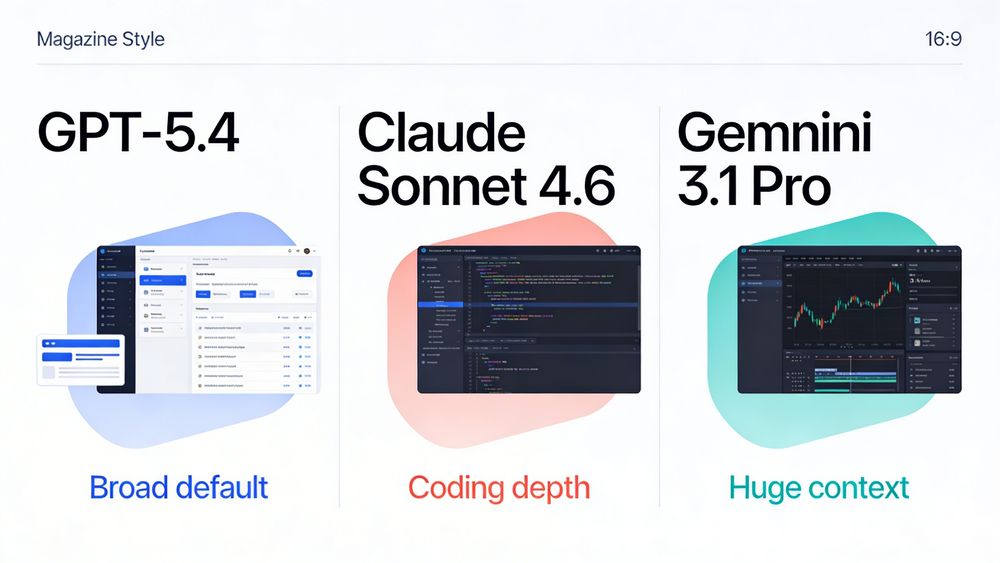
- GPT-5.4 is the safest "all-around" choice when you want broad capability, strong tool-oriented behavior, and fewer sharp edges across mixed tasks.
- Claude Sonnet 4.6 is often the most satisfying choice for serious coding, careful rewriting, and long-form reasoning where structure, tone, and edit quality matter.
- Gemini 3.1 Pro becomes extremely attractive when very large context, Google ecosystem access, search grounding, and multimodal input matter more than writing polish.
That is the executive answer. The real answer is more interesting.
Quick Verdict Table
| Model | Best for | Strongest trait | Main weakness | Best fit |
|---|---|---|---|---|
| GPT-5.4 | Mixed daily work | General balance across reasoning, coding, and tool use | Can feel less opinionated than Claude on heavy editing tasks | Teams that want one default model for many jobs |
| Claude Sonnet 4.6 | Coding and long-form writing | Clean code transformation and high-quality structured output | Smaller context than Gemini and less native Google ecosystem leverage | Engineers, analysts, and content teams doing dense work |
| Gemini 3.1 Pro | Huge context and grounded workflows | Very large context window, search grounding, multimodal utility | Writing style can feel less refined without prompt discipline | Research-heavy teams, multimodal pipelines, Google-centric stacks |
What Actually Matters in a Model Comparison
When people compare top-tier models, they usually ask the wrong question.
The wrong question is:
- Which one is "the smartest"?
The better questions are:
- Which one keeps quality high across messy, real prompts?
- Which one stays useful when the context gets large?
- Which one handles tools, files, code, and revisions with the least babysitting?
- Which one gives the best result per unit of attention from the operator?
That last point is underrated. A model can look amazing in a benchmark and still be expensive in human supervision. If it requires constant reprompting, correction, or restructuring, it is not really saving time. It is just moving the work around.
Where GPT-5.4 Wins
GPT-5.4 is the model I would pick if I had to support the widest variety of tasks with the fewest workflow surprises.
Its main advantage is not that it dominates every category. Its advantage is that it is difficult to corner. It is usually good enough or better in most practical tasks:
- coding and debugging
- structured extraction
- workflow orchestration
- tool-using agents
- rewriting and summarization
- prompt following under mixed constraints
That matters in production. Real systems are not clean benchmark tasks. A customer support workflow may need reasoning, retrieval, JSON output, policy handling, and a clean user-facing response in one pass. A product team may need a model that can review a PR comment, rewrite release notes, suggest a database migration summary, and then draft an internal FAQ. GPT-5.4 fits that kind of multi-role usage well.
Another reason GPT-5.4 is appealing is operator confidence. In many teams, the default model wins not because it is the absolute best in one category, but because it produces fewer avoidable mistakes across many categories. GPT-5.4 feels designed for that job. It is a strong "default slot" model.
Where it is less obviously dominant is in the feeling of the output. GPT-5.4 often feels competent before it feels distinctive. If your work depends on elegant long-form prose, nuanced refactoring, or careful document surgery, Claude may feel sharper. If your work depends on extremely large context and active grounding, Gemini may feel more natural.
Use GPT-5.4 when:
- You want one model to cover product, engineering, support, and operations use cases.
- You are building tool-calling workflows that need stable behavior more than personality.
- You care about reliable prompt following under layered instructions.
- You want to reduce model switching overhead inside your team.
Where Claude Sonnet 4.6 Wins
Claude Sonnet 4.6 is the model that most often feels like it understands the shape of serious work.
That matters in coding, but it is not limited to coding. Claude is often excellent when the task has one or more of these characteristics:
- you need a large block of text rewritten without losing meaning
- you want cleaner, more maintainable code, not just working code
- you need a structured answer with good internal logic
- you want the model to stay patient through a complex, multi-part prompt
This is why Claude remains a favorite among developers and technical writers even when competing models are strong on paper. It often produces fewer "almost right" drafts. The result feels closer to something you would keep.
Official Anthropic material also gives Claude Sonnet 4.6 a very clear production profile: it is positioned as the strongest coding model in that lineup, with a 200K input context window, 64K max output, and pricing that is straightforward for teams doing repeated API work. That makes it easier to reason about operationally than vague "frontier intelligence" messaging.
In hands-on work, Claude Sonnet 4.6 is especially strong in:
- repository refactors
- code review and bug isolation
- architecture explanation
- editing technical docs
- policy writing
- transformation tasks where tone and fidelity both matter
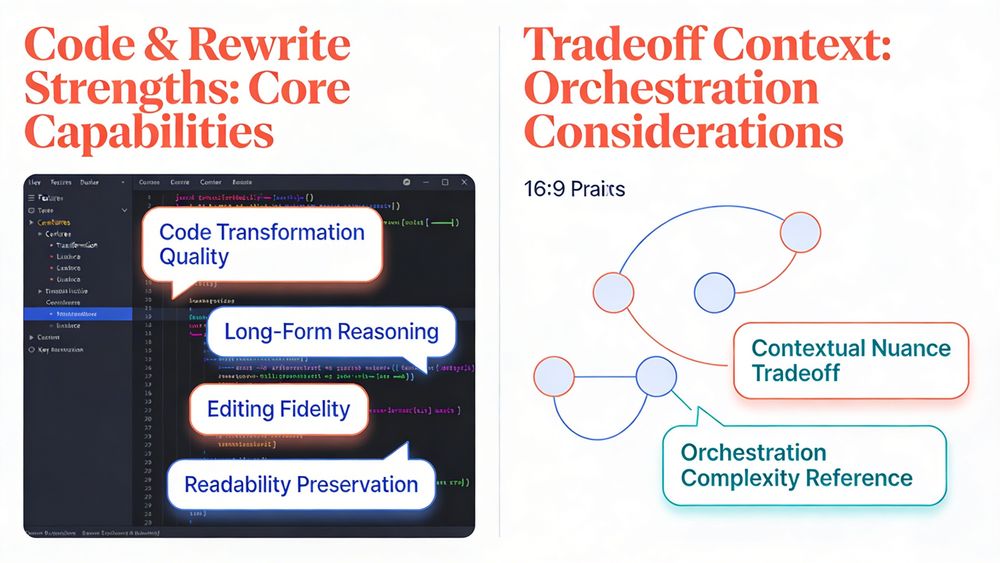
Its biggest tradeoff is that it is not the best choice when "the whole internet plus a massive document set" is your baseline workflow. Gemini's huge context and grounding options can be a better fit there. Claude also benefits from a user who knows how to ask for structure. It performs very well, but its best results tend to come from good prompt framing rather than raw improvisation.
Use Claude Sonnet 4.6 when:
- Your main bottleneck is code quality, not just code generation speed.
- You need dependable long-form editing and precise rewrites.
- You want answers that hold structure under long prompts.
- You are willing to trade some context scale for cleaner reasoning and output quality.
Where Gemini 3.1 Pro Wins
Gemini 3.1 Pro is the model that changes the conversation when context length becomes the problem.
Google positions Gemini 3.1 Pro around a 1,048,576-token input window with 65,535 output tokens, plus native support patterns around Google Search grounding, code execution, URL context, and function calling. That profile makes Gemini attractive in a very specific class of workflows:
- large document analysis
- multi-file synthesis
- research with live grounding
- multimodal tasks across text, images, audio, and video inputs
- long context pipelines where chunking is expensive or lossy
This is not just a spec-sheet advantage. Large context changes prompt design itself. Instead of compressing everything into smaller summaries before the model sees it, you can often keep more source material intact. That reduces pre-processing overhead and can preserve nuance in research or enterprise document work.
Gemini is also a strong choice when your workflow already leans toward Google infrastructure, or when grounding matters. If the question is not only "reason about this" but also "reason about this while staying anchored to current web information," Gemini becomes much more compelling.
The tradeoff is output feel. Gemini can be very capable, but it does not always deliver the same immediate polish that Claude often gives in writing-heavy tasks. It can also encourage lazy prompting because the context budget is so large. Teams sometimes throw everything at the model, then wonder why the answer is broad rather than sharp. Gemini rewards disciplined information architecture even when it gives you space to be messy.
Use Gemini 3.1 Pro when:
- You routinely work with giant source sets.
- You need live grounding, search, or multimodal input inside the same workflow.
- You want to reduce aggressive chunking and retrieval overhead.
- Your team already operates deeply inside the Google stack.
Side-by-Side Comparison by Workflow
| Workflow | Best default choice | Why |
|---|---|---|
| Full-stack coding | Claude Sonnet 4.6 | Often stronger at refactors, repo reasoning, and code quality decisions |
| Broad product work | GPT-5.4 | Best all-around balance across mixed tasks |
| Research with huge source sets | Gemini 3.1 Pro | Large context and grounding change the workflow economics |
| Technical writing | Claude Sonnet 4.6 | Better control over structure, tone, and fidelity |
| Tool-calling agents | GPT-5.4 | Strong default behavior for orchestrated tasks |
| Multimodal analysis | Gemini 3.1 Pro | Broad input support and long context are naturally useful |
| Executive summaries from many docs | Gemini 3.1 Pro | Easier to keep more primary material in-context |
| Product spec drafting | GPT-5.4 or Claude Sonnet 4.6 | GPT for breadth, Claude for polish |
How They Differ on Coding
For coding, the choice is not simply "which model writes more code." It is "which model reduces the total time from issue to trusted merge."
Claude Sonnet 4.6 usually excels when:
- the codebase is non-trivial
- the bug is buried under abstractions
- the refactor must preserve readability
- the answer needs explanation, not just a patch
GPT-5.4 is excellent when:
- you have mixed work around the code itself
- you want generated code plus surrounding product logic
- you are combining analysis, JSON, tool use, and implementation
- you need one model for both human-facing and machine-facing outputs
Gemini 3.1 Pro becomes interesting when:
- the repo or documentation context is large
- you need to ingest many files at once
- architecture references live across multiple long docs
- video, images, support transcripts, and code all need to be reasoned about together
My practical recommendation is simple:
- If your team lives in IDEs all day, start with Claude Sonnet 4.6.
- If your team builds agentic product workflows, start with GPT-5.4.
- If your team works across giant documentation and multimodal inputs, start with Gemini 3.1 Pro.
How They Differ on Research and Decision Support
This is where many buyers underestimate Gemini.
Once your workflow includes:
- long PDFs
- product docs
- meeting notes
- search grounding
- source comparison
- large synthesis tasks
Gemini 3.1 Pro becomes much harder to ignore. The larger context window is not just a technical detail. It changes how much pre-processing your team must do before the model can help.
That said, GPT-5.4 still has an important role here because research rarely ends with research. It ends with action:
- turn the findings into a decision memo
- extract structured output
- draft a rollout plan
- propose next steps
GPT-5.4 is strong at that "from analysis to operational next move" step. Claude is strong at the "make this explanation clean, careful, and easy to trust" step.
So if your research pipeline includes both discovery and communication, many teams will actually prefer a two-model stack over a single-model ideology.
Parameter and Prompting Recommendations
| Model | Best prompt style | Temperature guidance | Extra advice |
|---|---|---|---|
| GPT-5.4 | Structured task framing with explicit output requirements | Low for workflows, medium for ideation | Be clear about tool use, output schema, and success criteria |
| Claude Sonnet 4.6 | Detailed instructions with reasoning constraints and format expectations | Low to medium | Ask for tradeoffs, not just answers; Claude responds well to editorial framing |
| Gemini 3.1 Pro | Context-rich prompts with source grouping and explicit priority rules | Low for analysis, medium for synthesis | Organize long context into labeled sections instead of dumping everything raw |
This table matters because teams often compare models with one shared prompt and then declare a winner. That is a weak evaluation method. Frontier models have different strengths, so they should not all be driven exactly the same way.
Which Model Should Most Teams Choose First?
If you can test only one model first, choose based on your bottleneck:
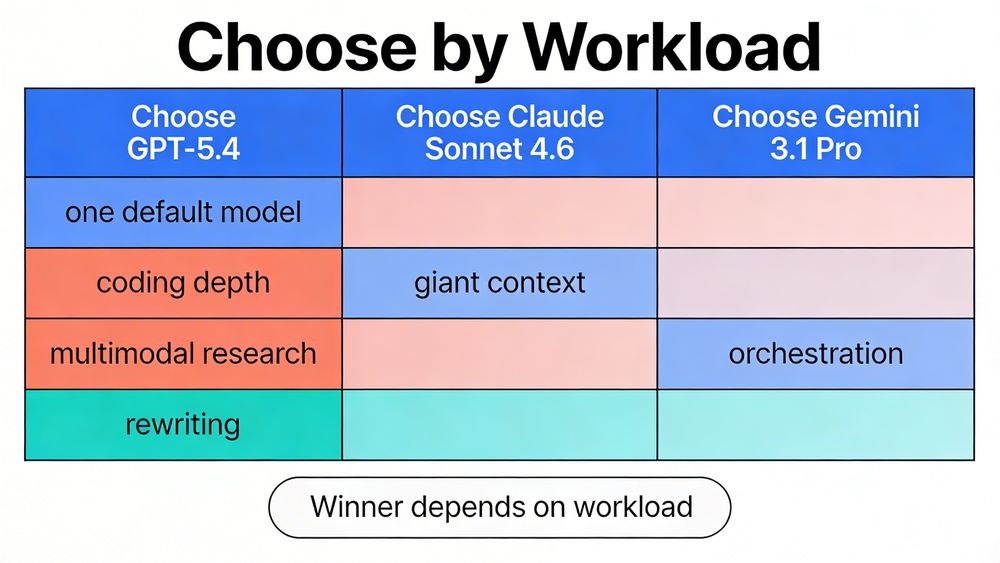
- Choose GPT-5.4 if your organization wants one broadly capable default model.
- Choose Claude Sonnet 4.6 if engineering quality and precise writing are your highest-value outcomes.
- Choose Gemini 3.1 Pro if context scale, grounding, and multimodal synthesis define your work.
If you can afford two:
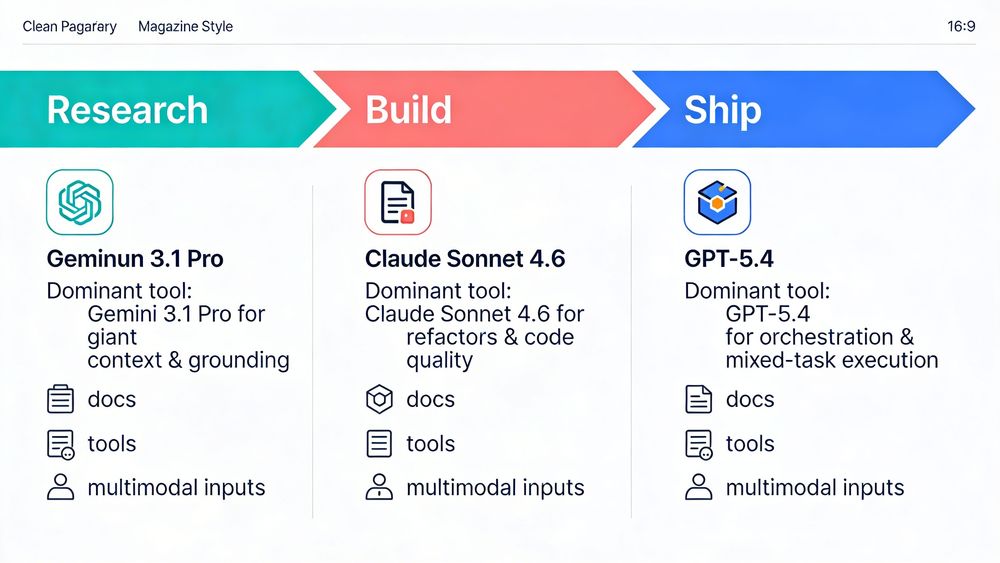
- GPT-5.4 + Claude Sonnet 4.6 is a very strong pair for product and engineering teams.
- Gemini 3.1 Pro + Claude Sonnet 4.6 is a strong pair for research-heavy technical organizations.
- GPT-5.4 + Gemini 3.1 Pro is a strong pair for operations-heavy teams that need both orchestration and giant-context analysis.
If you can afford three, the better question is not "which one wins?" It is "which task gets routed where?"
That routing mindset usually creates more value than arguing for a single universal champion.
Final Verdict
There is no honest universal winner between GPT-5.4, Claude Sonnet 4.6, and Gemini 3.1 Pro.
There is only a winner for your workload.
GPT-5.4 is the strongest one-model default for broad business use.
Claude Sonnet 4.6 is the strongest specialist for coding depth, structured reasoning, and high-fidelity rewriting.
Gemini 3.1 Pro is the strongest choice when scale of context and grounded multimodal work become the real constraint.
If your job is to make a team faster, do not ask which model is smartest in the abstract. Ask which model removes the most operational friction from the work you actually do every day.
That is the comparison that matters.